Imagine what would happen if a new athlete showed up at your gym without their parent or guardian introducing themselves or knowing anything about your gym. You would likely struggle to place them in the right level and train them, and the athlete might have trouble adjusting to your gym’s environment and culture.
This scenario illustrates why gymnastics registration forms are so important. They help you collect the information you need to support and train your athletes effectively. Additionally, these documents allow gym athletes and their families to understand your gym’s policies and procedures, working with your staff to foster a safe, welcoming environment.
In this guide, we’ll help you develop comprehensive gymnastics registration forms to ensure everyone’s on the same page:

Gymnastics Registration Form FAQs
What is a gymnastics registration form?
A gymnastics registration form is an administrative document that parents or guardians complete to enroll their children in a gymnastics facility’s classes, camps, or competitive teams. This type of document allows your gym to gather crucial athlete information and informs athletes and their families about your gym’s policies.
Why are gymnastics registration forms important?
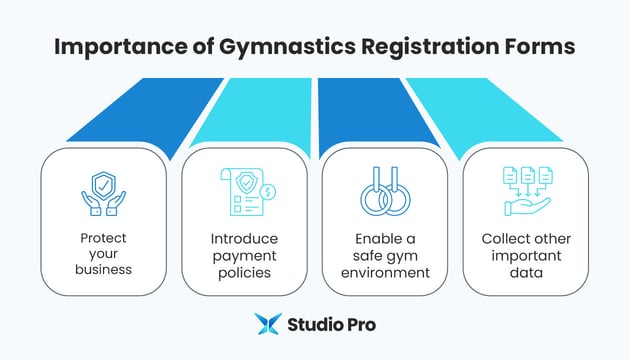
Gymnastics registration forms are important because they allow you to:
-
Protect your business. Since gymnastics comes with high risks, you’ll want athletes and their families to understand those risks from the beginning. Your gymnastics registration form allows parents or guardians to assume those risks, preventing any liability on your gym’s part. Plus, by adding a media release to your form, you can have parents or guardians provide informed consent for your gym to use photos and videos of their child for marketing purposes.
-
Introduce payment policies. When a parent or guardian receives their first bill from your gym, it shouldn’t be a surprise. Introduce your payment structure within your gymnastics registration form so gym families know the full cost of attendance before signing up.
-
Enable a safe gym environment. To ensure everyone’s safety, your coaches need access to athletes’ pertinent medical history, allergies, and current medications. You can also use your gymnastics registration form to obtain a parent or guardian’s consent to treat their child if they’re unreachable during a medical event or emergency.
-
Collect other important data. Delivering the best experience possible for your athletes requires truly getting to know them. With a robust gymnastics registration form, you can collect information like athlete birth dates, clothing sizes, and mastered skills, allowing you to offer the training and resources each athlete needs to succeed.
What elements should I include on my gymnastics registration form?
A robust gymnastics registration form should include several different key elements, including:
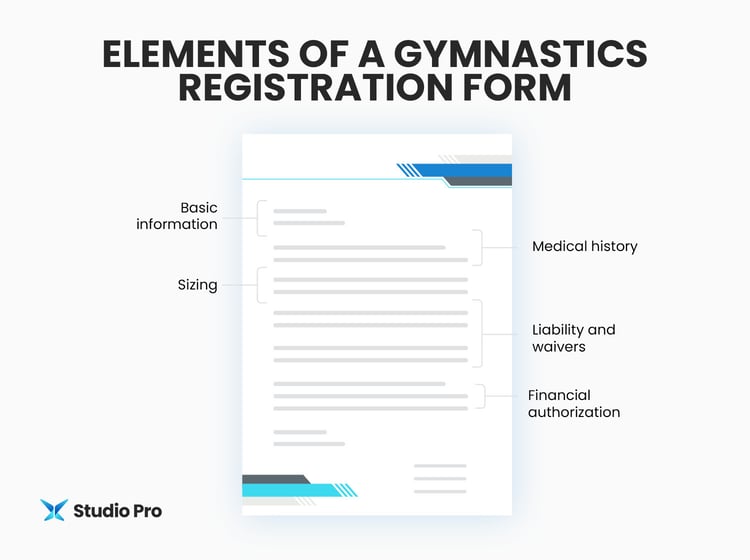
Basic Information
Cement a fundamental understanding of new athletes by collecting the following pieces of basic information:
-
Athlete and parent or guardian names. Gather the names of new athletes and their parents or guardians to ensure you address them appropriately.
-
Athlete birth date and grade level. Knowing an athlete’s age can help place them in the correct group—especially when competing in USAG-sanctioned meets—although you’ll also need to know their skill level.
-
Parent or guardian contact information. Collect phone numbers, email addresses, and physical addresses so you can stay in touch with athletes and their families.
-
Emergency contact information. Request contact information for someone else you can reach out to in case of an emergency if parents or guardians are unavailable.
Medical History
In the case of an emergency, you’ll need information about each athlete’s medical history on file, such as:
-
Allergies and chronic conditions. Your gymnastics registration form should have a space where families can notify you of any allergies or chronic conditions their athlete may have and any steps they take to help their child during a medical emergency, so your team knows what to do. For example, if an athlete has asthma, their parent may explain how to help the child use their inhaler during a flare-up.
-
Insurance details. If an athlete needs medical treatment on the spot, it will be helpful to have their insurance information on file, such as the provider name, policy number, and group number.
-
Consent to treat. There may be situations when a parent or guardian isn’t available during a medical emergency. To ensure efficient care, obtain their consent for you or a medical professional to treat their child.
Sizing
The sizing information you collect will depend on the type of registration form you’re creating:
-
For recreational classes and camps, you likely only need the athlete’s t-shirt size.
-
For competitive teams, you may want to collect chest, waist, hip, and girth measurements if you’re planning to order custom-fitted leotards or warm-up tracksuits.
Liability
To protect your business from potential liability and keep your gymnastics families informed, your gymnastics registration form should include:
-
Risk acknowledgment. List the physical risks associated with gymnastics. You may want to break this up by level, so families know which risks they have to be aware of for their child. Additionally, if you’re offering mommy-and-me classes or a similar program, you may have parents or guardians assume risk for their participation as well.
-
Media release. Give parents or guardians the opportunity to grant you permission to use photos and videos of their athlete within your marketing materials.
-
Code of conduct. Attach your gym’s policies so athletes and their families know what’s expected of them. Common elements of a gym code of conduct include social media rules, practice etiquette, and competition day sportsmanship. Clarify athlete and parent or guardian responsibilities in upholding your gym’s positive culture and environment, as well as any consequences for violating these rules.
Financial Authorization
Your gymnastics registration form should feature your payment schedule so families know what they’re expected to pay and when. If an athlete is signing up in the middle of the season, you may also offer prorated tuition and explain the calculation you used to arrive at this number. By integrating your registration form with your billing software, you can also enable payments at the time of registration and set up Auto-Pay.
Gymnastics Registration Form Best Practices
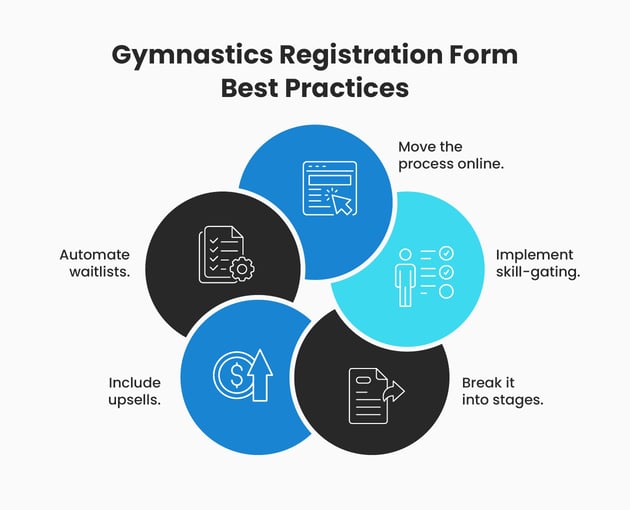
When creating your gymnastics registration form, keep the following best practices in mind:
-
Move the process online. First and foremost, ditch the physical forms and conduct the entire registration process online. With gymnastics registration software, families can easily complete their registration, and you can effortlessly integrate the information they provide with your existing stored athlete data. For instance, instead of writing out their health insurance information, families can simply upload a photo of their insurance card. Additionally, when you digitize registration, you can collect payment right away and have parents set up Auto-Pay to ensure timely payments.
-
Implement skill-gating. Parents tend to overestimate their child’s skills. To ensure each athlete signs up for the correct classes, use your registration software to gate classes based on skill level. Allow new students to select beginner or preschool classes directly from your public-facing registration form. For more advanced classes, you may require an evaluation and provide a code that unlocks access to these classes if athletes qualify.
-
Break it into stages. Make your gymnastics registration form more digestible by breaking it up. You may ask new gym families for their basic information on one page, medical history on the next page, and so on. This setup streamlines the process and encourages prospects to follow through.
-
Include upsells. When new athletes and their families register, they’re often eager to get new gear that allows them to show off their affiliation with your gym. Don’t make them wait to visit your gym’s store in person. Instead, embed merchandise upsells directly into the registration process to capitalize on their purchasing momentum. For example, you may create a starter kit with a branded leotard and water bottle that new families can add to their carts before submitting payment.
-
Automate waitlists. If a parent is trying to sign up for a class that's already full, they shouldn’t have to monitor the waitlist on their own. Have your registration form transition the user to a waitlist lead capture form so you can obtain their contact and payment information. Then, when a spot opens up, your system can automatically notify them and process the enrollment, ensuring you don’t miss out on the lead.
5 Gymnastics Registration Form Templates
To help you create your own gymnastics registration forms, we’ve developed a few templates with the best practices we’ve covered in mind.
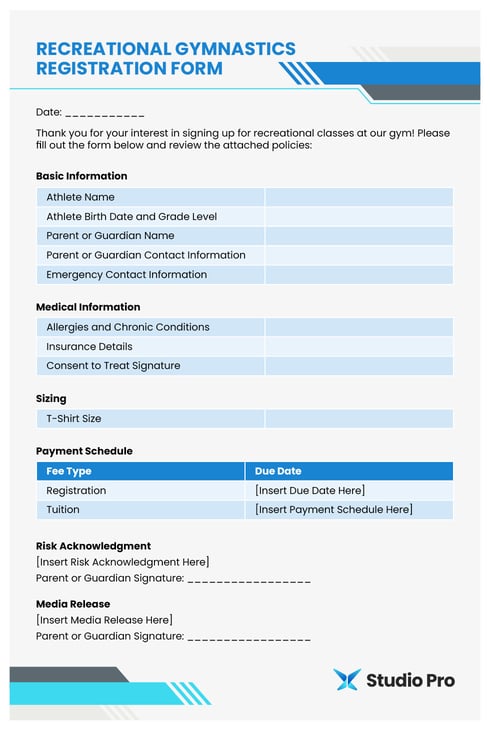
1. Recreational Gymnastics Registration Form
Parents signing their children up for recreational gymnastics want a form that’s easy to complete. On your end, you should only need some basic information from them to get started, so you can keep this form fairly short. Focus on the essentials, like parent or guardian contact information, medical history, and payment details.
Here’s what this form might look like:
2. Gymnastics Trial Class Registration Form
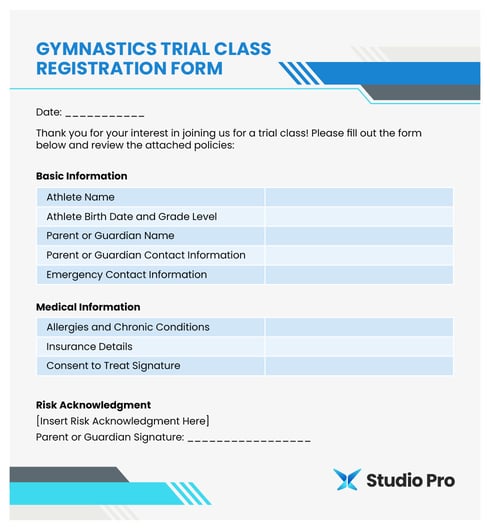
If you offer trial classes or skill evaluations, your registration form should act as a low-friction lead capture, obtaining parent or guardian contact information and the child’s age. Additionally, this type of form should include a basic liability waiver to protect your business in case of injury.
Your trial class registration form might look something like this:
3. Gymnastics Camp Registration Form
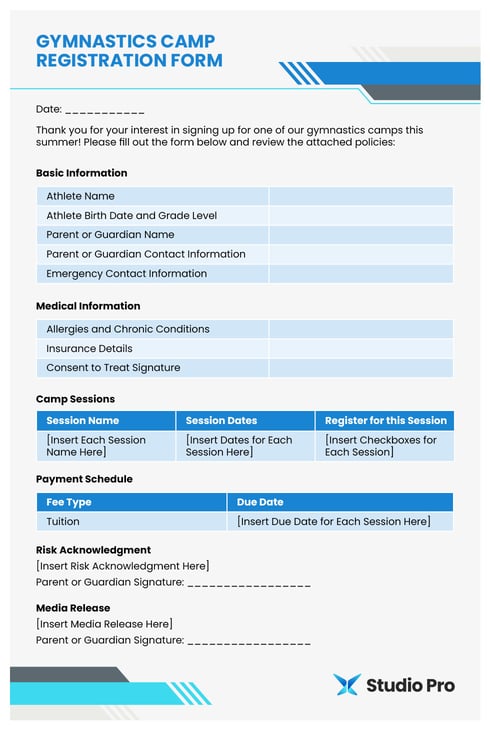
For an offering as short as a camp, the accompanying form should be brief and focus on securing immediate payment. Collect key details, such as contact, medical, and payment information, and allow athletes to sign up for their desired session.
Take a look at this example:
4. Competitive Gymnastics Team Registration Form
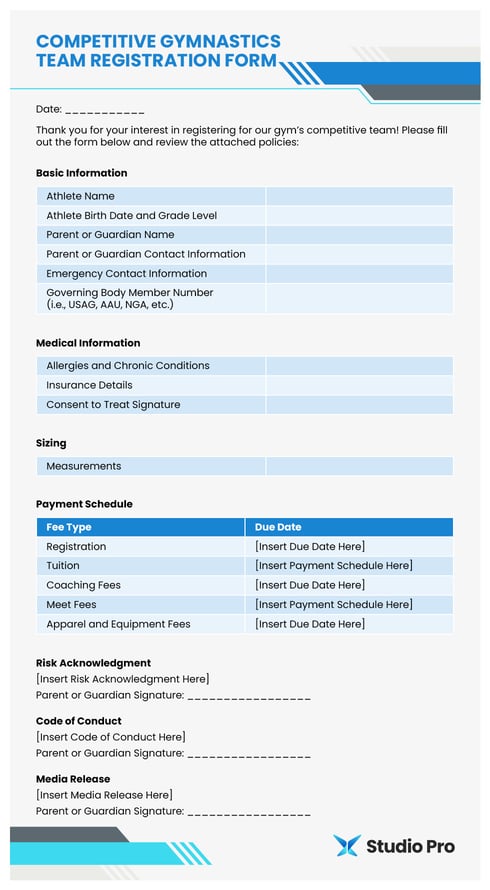
When an athlete signs up for your competitive team, you’ll want to make sure you adequately inform them about what to expect. Compared to your other forms, your competitive gymnastics team registration form should be much more detailed, with information about your payment schedule, policies, and code of conduct. You may also include a field to collect the athlete’s USAG, AAU, or NGA member number with a link to register for the appropriate governing body if they haven’t already.
Check out an example of this form type:
5. Special Event Gymnastics Registration Form
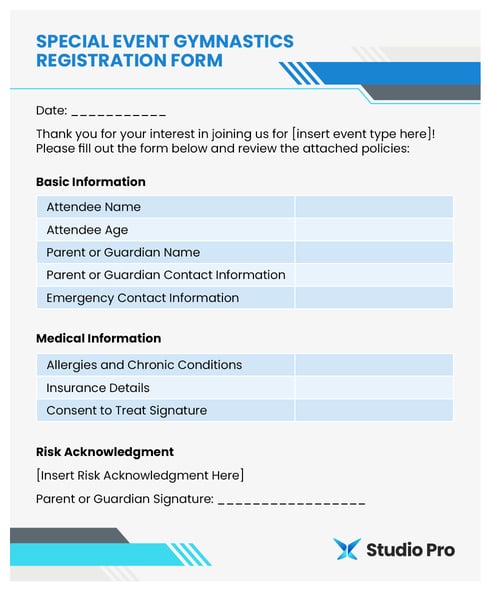
If your gym hosts events like open gyms, birthday parties, or parents’ nights out, you’ll need a special events registration form. Since many attendees will likely not be current members of your gym, you’ll want them to fill out a quick form that includes a liability waiver, medical consent to treat, and a parent signature.
You may use a form like this and have a QR code at your front desk that links directly to it for easy access:
Gymnastics Registration Form Assessment
If you’ve already created gymnastics registration forms, leverage the checklist below to assess them and see how well you’re following the best practices in this guide.
Streamline Gymnastics Registration with Studio Pro
Comprehensive gymnastics registration forms allow you to gather crucial information about new athletes and their families, inform these new members about your gym’s policies, and ultimately provide a smooth, safe experience for everyone involved. By using our templates, you can get up and running faster, leaving you more energy to train your athletes.
Further simplify the registration process with Studio Pro’s registration software. Our system is equipped to register gymnastics families quickly, allowing them to sign up and pay online with ease. To learn more about our registration solution, sign up for a free 30-day trial today.
For more information on how to run your gymnastics gym, explore these additional resources:




.png?width=596&name=Cheer%20Registration%20Form_Feature%20(1).png)