Imagine you’ve just
started a dance studio. You dream of having dancers flood through the doors, ready to express themselves and form the community you’ve longed to create.
However, you need a loan to get your studio off the ground.
How can you prove that your studio is well thought out and worthy of funding when you’ve barely gotten started?By creating a dance studio business plan, you establish a solid foundation for your business that you, potential investors, and team members can rely on. It will centralize essential information about your studio and inform all future business decisions, setting your studio up for success.
This guide will explain how to develop a comprehensive dance studio business plan and present an example to help you get started:
Frequently Asked Questions About Dance Studio Business Plans
What is a dance studio business plan?
A dance studio business plan is a comprehensive document that serves as the operational and financial roadmap for your studio. This type of document allows you to translate your vision for your studio into a viable, profitable business.
Do I need a business plan if I’m not applying for a loan?
Yes. Even if you are completely self-funding your studio, you still need a business plan to provide direction for yourself and your team. Taking the time to lay out a dance studio business plan empowers you to define your target audience, analyze local competitors, set clear revenue benchmarks, and build a marketing strategy. While opening your own studio can be stressful, having this information at your disposal can keep you on track to achieve your goals.
How long should a dance studio business plan be?
The length of your dance studio business plan will depend on what you’re using it for:
-
A traditional, formal dance studio business plan that you would use to secure a commercial loan is typically somewhere between 15 and 25 pages. To obtain funding, you’ll need a robust plan that includes elements like detailed financial projections and market data.
-
A lean dance studio business plan intended for internal use only might be closer to two to five pages long. This type of plan might focus more heavily on your core mission, target demographic, class pricing, and budget to get your team started.
However, these are only estimates. For best results, make your plan as comprehensive as possible, whether you’re using it to secure funding or guide your internal team.
How do I estimate financial projections for my business plan before opening?
When creating the financial section of your business plan, you’ll need to estimate your one-time startup costs and ongoing monthly overhead. To make these projections as accurate as possible, follow these steps:
-
Research the costs of your equipment and lease deposit.
-
Map out your expected monthly recurring expenses, such as rent, utilities, instructor payroll, insurance, and dance studio management software.
-
Forecast revenue by estimating how many students you must enroll at potential tuition rates to break even and make a profit.
How do I determine the right pricing for my dance classes?
To determine the right pricing for your dance classes, you’ll need to conduct a thorough market analysis. Research what competing studios in your local area charge for their offerings to better understand what is reasonable for your studio to charge.
Then, factor in your monthly overhead costs. You’ll want your pricing to cover these operational expenses, while also reflecting the unique value your studio provides. For example, if you hire an instructor who has choreographed for multiple recording artists to teach your commercial jazz classes, you would be justified in charging more than if you were to have a high school student teach the same classes.
How often should I update my dance studio business plan after my studio opens?
Your dance studio business plan should be a living document. Once you’ve developed your plan, review and update it annually.
At the end of the season, compare your actual financial performance to the projections in your plan, and if there are any shortfalls, determine how you can strengthen your strategy moving forward.
Additionally, whenever you make a large change to your business, you should revise your plan accordingly. For example, if you decide to expand your studio to a second location, this pivot would significantly change your business model and expenses, so you’d want to revisit your initial plan.
7 Steps to Develop a Dance Studio Business Plan
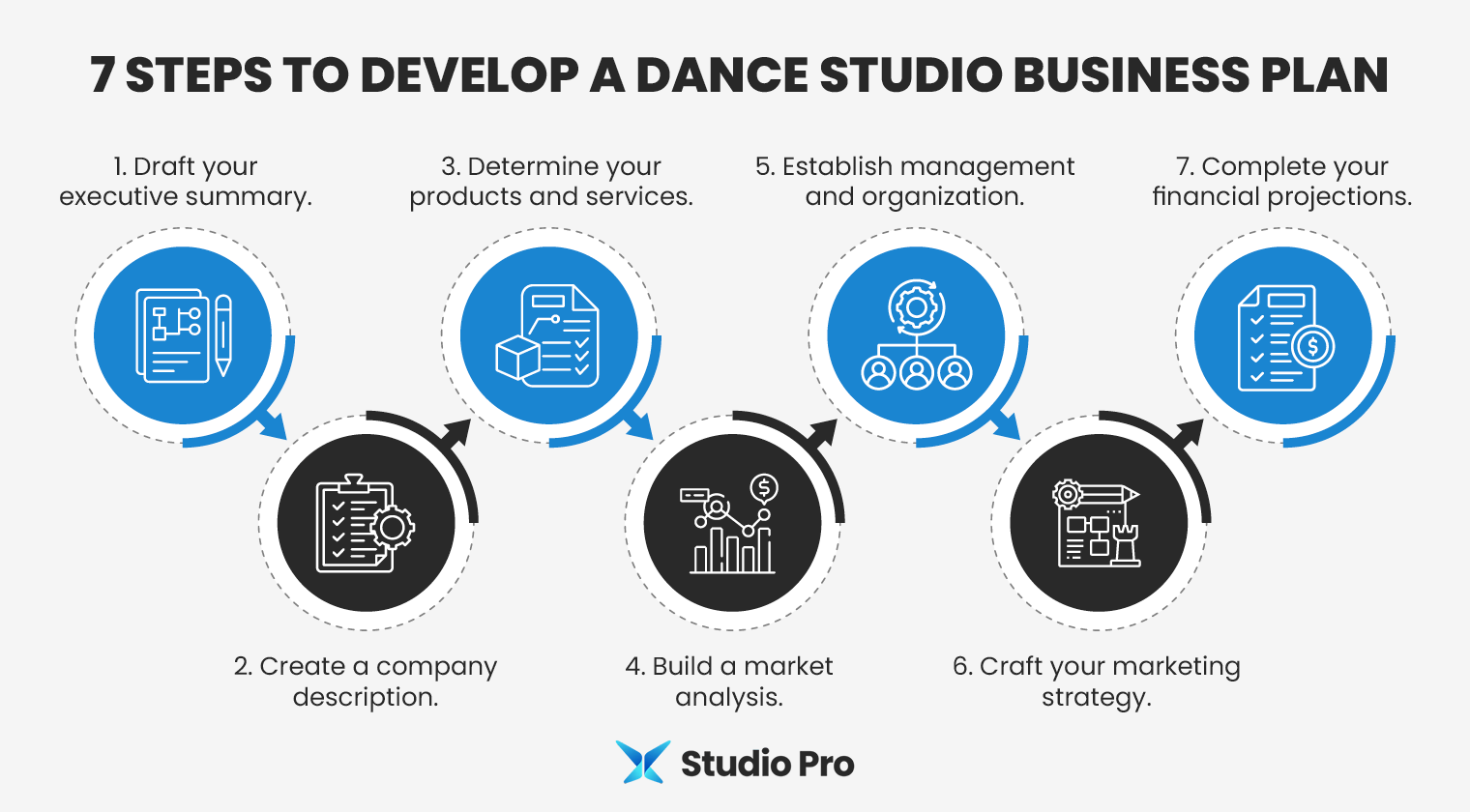
1. Draft your executive summary.
The executive summary is a synopsis of your business plan. Think of it as an advanced table of contents that outlines key points for the reader as they move through the rest of the document.
Your executive summary is your best chance of capturing your reader’s attention, so make it concise but also compelling. Although this portion appears first in your business plan, experts recommend you actually write it last, once you’ve finalized the rest of the content.
Include these components in your executive summary:
- Your reason for starting your business
- The need you’ll be fulfilling in the community
- A summary of your products and services
- An overview of the market conditions of the dance industry
- A brief outline of your marketing plans
- A snapshot of financial obligations and projections
Keep your executive summary brief—no more than 1-2 pages. If you’re seeking a loan for your studio, include a short description of the amount you’re requesting and what you’ll use the funds for at the end of the executive summary. Use an upbeat tone to set an optimistic mood for readers as they continue through your business plan (or for yourself, as you read back through your business plan later for guidance).
2. Create a company description.
The next step involved in crafting your dance studio business plan is to create a company description. The company description is a chance to go into detail about the specific characteristics of your dance studio. We suggest answering these questions as you write:
- Who are you? Introduce yourself, describe your past experience in the dance industry, and include the official name of your business.
- How is your business structured? Describe your studio’s business type— whether it’s a corporation, partnership, sole proprietorship, etc.
- Where are you located? Write your business address and intended hours of operation.
- What is your mission statement? Develop a sentence or two that encapsulates your purpose for running your dance studio.
- What are you selling? Identify the products and services you’ll provide.
- How will you stand out? Pinpoint the aspects of your business that set you apart from competitors, whether it’s the product or service you’re offering and/or the audience you’re targeting.
- What are your business goals? Discuss where you see the business going in the future based on market trends and predictions.
- How will you achieve your goals? Highlight your plans for marketing your business to achieve growth.
Once you’ve answered these questions, you’ll have a thorough company description that communicates your business’s purpose and mission. Reference this section as you write the rest of your dance studio business plan to ensure all the explanations align with your company description.
3. Determine your products and services.
In this section, go into more detail about the products and services you’ll offer at your dance studio. Make sure to:
- Explain whether you’ll host both live and virtual classes or just in-person classes.
- Specify the type of lessons you’ll hold—group, private, or both—and in which dance styles.
- Note the age range you’ll cater to.
- Mention the dance accessories or equipment you plan to sell, such as jazz shoes, costumes, or warm-up clothes.
- Indicate any events you’ll sell tickets for, like workshops, retreats, and recitals.
List the current or predicted cost of your products and services, and explain how they fulfill a certain need in the market. For instance, you may explain that you’re offering classes at a discounted rate so they’re accessible to all or that you’re running adult classes late at night to accommodate working professionals who still want to pursue their passion for dance.
4. Build a market analysis.
In the market analysis section, prove your dance industry knowledge by describing the current state of the dance market, where your business fits in, and how you see the market changing or growing in the future. Use data and statistics to paint a picture of your business metrics, such as your target demographic and their income level.
Additionally, describe the size and scope of competing dance studios in the area, along with the strengths and weaknesses of competitors. Highlight where your dance studio fits into the existing market to fill a need. For example, you may explain that you’re opening a tap-only studio since none of the dance studios in your local area focus heavily on tap, and you trained primarily in tap.
You can also describe barriers to entry in the dance studio industry—the factors that make it hard for someone to open a dance studio—that protect you from new competitors threatening your business and crowding the market.
As you build your market analysis, consider conducting a SWOT analysis for your own business, identifying its strengths, weaknesses, opportunities, and threats:
- Strengths: What are the aspects of your business that will allow you to do well in the market?
- Weaknesses: Where is there room for improvement? How can you implement these improvements?
- Opportunities: What opportunities are available for your business to take advantage of? Have any recent trends or changes in the market presented new avenues for your business to explore?
- Threats: What threats are you facing from your competition or other external factors? Where do your weaknesses leave you exposed?
If you’re using your business plan to attract potential investors, you’ll want to focus on your strengths and opportunities to reassure investors or loan managers that your business has a solid foundation of advantages and opportunities for growth. Then, you can identify your weaknesses and threats for yourself to help you understand where your business can improve.
One of the top opportunities to improve your business is by implementing the latest tech available for dance studios. This includes powerful dance studio management software that helps you organize your business operations and marketing efforts to stand out against competitors. Take note of the opportunities you uncover to take actionable steps and make the most of these untapped possibilities.
5. Establish management and organization.
Introduce the key players at your dance studio—your staff and instructors. Describe their backgrounds, level of dance industry expertise, and daily responsibilities.
Use this section to make your staff shine. Highlight their expertise in the field and any certifications or qualifications they bring to the table. If you’re using your business plan to attract investors, showcasing your staff’s experience and leadership abilities helps inspire more confidence that your business is a good investment and has the assets to succeed long-term. You’ll also want to mention any new or unfilled positions at your studio and the qualities you’ll look for in new hires.
If you’re searching for a platform to help manage your instructors and other staff more efficiently, Studio Pro’s teacher management features allow you to send reminders to staff members about upcoming events and classes and provide detailed lesson plans to instructors. These tools help your instructors become even more effective managers and leaders.
6. Craft your marketing strategy.
Now that you’ve identified the audience you’ll serve, the conditions of the dance industry market, and your staff members’ expertise, describe your plan to advertise your business and entice your audience to join your studio.
When creating your marketing strategy, consider the four Ps of marketing: product, price, place, and promotion:
- Product: Identify the goods and/or services you’re selling, which you described in a previous section.
- Price: Analyze market trends to identify the right price to charge for your dance classes and other studio offerings.
- Place: Describe where your business is located and the area where you’ll be focusing your marketing efforts.
- Promotion: Finally, lay out your strategy for promoting your business. Explain how you’ll get your studio information in front of your audience to convert them into new students.
For the promotion element of your strategy, use various marketing channels, such as social media, local radio or TV ads, direct mail appeals, and flyers, to connect with prospective students. Investing in a range of marketing channels ensures you reach your target audience enough times that they become interested in your studio without being overwhelmed.
Additionally, your marketing materials should include a link to sign up for your email and text lists. You can send updates and promotions to these contacts through robo-messaging tools to quickly and efficiently communicate with all prospective students at once.

7. Complete your financial projections.
The final component of your dance studio business plan is a summary of your financial situation. Provide information on how much you expect to earn compared to your business costs and how you expect your business to grow over a five-year period.
This section should include:
- A cost breakdown, including expenses such as employee salaries and your studio overhead costs, like rent, software, and equipment. Use your market analysis to make an educated prediction of your expected revenue for each year of operation up to five years.
- A cash flow statement based on profit estimates.
- A balance sheet describing your assets and liabilities.
- An estimate of when your business will break even.
If you’re using your business plan to apply for a loan, include another section to describe your funding request and how you plan to use the money that goes beyond what you included in the executive summary. Other than that, once you’ve completed your financial projections, your business plan is ready to present to investors or serve as a guiding plan for getting your dance studio up and running.
Dance Studio Business Plan Template
To help you visualize what this might look like in practice, check out this dance studio business plan template:
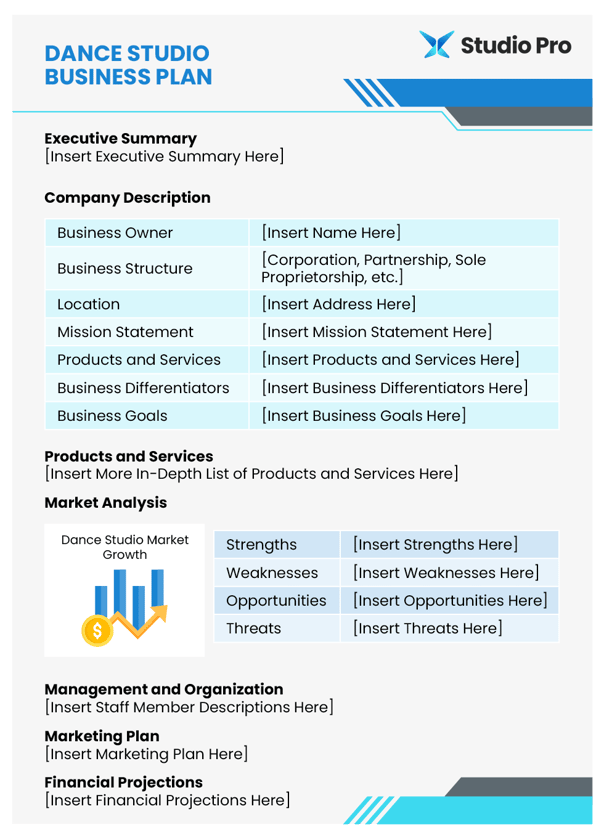
To take this a step further and get started right away, use our interactive dance studio business plan template:
Start Strong with Your Own Dance Studio Business Plan
Your business plan will serve as a guiding force behind your business as it grows and adapts to changing market conditions. When done right, this document takes a considerable amount of time to construct, so get started on your plan early to ensure success.
Once you’ve gotten your studio off the ground, consider investing in dance studio management software to keep your business running smoothly. From tuition auto-pay that ensures consistent monthly cash flow to communication tools that help you stay in touch with your community, Studio Pro improves countless aspects of studio operations. If you’re ready to enhance your studio today, sign up for a free 30-day trial!
For additional resources on how to achieve success with your dance studio, check out these guides:
Laura Cole, CEO and Business Leader of Studio Pro

Laura Cole is the CEO and Business Leader of Studio Pro, a leading studio management software platform serving over 6,000 studios across all 50 U.S. states and more than 35 countries. Laura brings deep expertise in SaaS operations, strategic planning, and project management, with a passion for helping dance, cheer, gymnastics, and performing arts businesses grow and thrive.
Since taking the helm in 2020, she’s been dedicated to building tools that streamline studio operations and empower small business owners to succeed. When she’s not leading Studio Pro or partnering with studio owners, Laura enjoys running, yoga, and hosting friends at home with her husband and two young boys.